
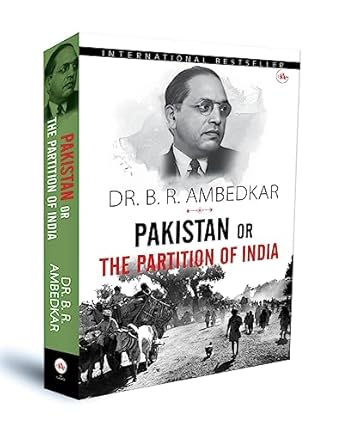
Why I Picked This Book
Continuing from my last book, The Discovery of India by Pandit Nehru, I picked up this book given to me by my brother.
The book is Pakistan or the Partition of India by Dr. B.R. Ambedkar.
And why I picked this one—the reason is the last book, I would say. The last one piqued my curiosity around the Partition, one of the most eventful slices of history India endured and witnessed. This history would shape years and centuries to come for South Asia.
Today, we are witnesses to the repercussions it had on the geopolitics of our subcontinent and, more importantly, on the global stage. Be it Central or West Asia, the Middle East, and gateways to Europe—all were shaped by the humongous effect the Partition would bring.
Why did it happen? Who were the players? What were the social, societal, and political compulsions resulting in this massive event?
On my quest to know and realise this slice of history, I embarked on the journey to find answers. That’s why this book.
As always, with my nascent understanding of the complex history of Asia, I will try to put forward my observations based on the book.
Culmination.
The Lahore Declaration of 1940—I would say—was the start of the culmination of a multitude of disagreements and politics behind the Partition. I would not say this was the reason, but here the first ratified ideas were presented. I will reject any connotation that this declaration brings; we need to delve further.
Ambedkar’s Arguments
Ambedkar argues on behalf of both notions—the unified and the divided. He cites spiritual alienation and social hostilities of two mindsets owing to invasions from Mongols, Timurs, Sultans, and Mughals, which resulted in cataclysmic societal changes. The bitterness existed between the two factions for sure, and it’s not a sudden event—it was culminating for ages.
Ambedkar dives deep into how the formation and participation percentage of the army from different cultures and religions can argue for a division. The summation of this thought is: “A safe army is better than a safe border.” This statement has a much deeper meaning—it will surely enlighten current-day thinkers and scholars. Yes, like any other investigative outcome, this may also be argued by someone, but without a doubt, this takeaway evokes thought for sure. He points out how the army runs, where the funds come from, and what can be the preponderance angle—subtle and intelligent. This is in Chapter V.
P.S. And what’s forward policy? I am sure you would have heard of this term used by China in justification of the 1962 war—this term finds a place in this book, albeit envisioned by different participants—the British. This policy of expansionism enabled the British to widen their sphere of influence towards the west of India.
Revelations. Alternatives.
You will be utterly surprised at the revelations this book makes—from the speeches, declarations, and the conclusions by the then leaders of India. I don’t want to spill the beans here—it’s for you to find out and see your biases challenged. What’s the difference between a national home and a national state? Truly, the revelations are startling, and their repercussions—this book adequately explains the same. Ambedkar has been quite candid in the book.
Coming to the alternatives to Pakistan, or the division based on homogeneity, culture, and affinities: the author dissects the subject under the following heads:
- Hindus’ alternate options
- Muslims’ alternate options
- Lessons from abroad
For the first head, the author quotes Savarkar, the president of the Hindu Mahasabha, and his speeches. Hinduism, Hindutva, Hinduness, Hindudom—these terms are elaborated in this section through the speeches quoted.
Yes—without a doubt—in the absence of affinity, identity, common heritage, and racial and linguistic coherence, imagining a national state can be disastrous. India, for years, stands tall as a national state because of these vitals, even with substantial diversities. These quoted speeches, irrespective of your viewpoint, surely deserve a look.
One of the takeaways for me from this section: the treatment of everyone as equal citizens, while assuring maintenance of respective cultures and without complicating the societal fabric with terms like majority and minority.
Coming to the unity of different religious communities, the author notes the disturbing events between 1920 and 1940. Despite herculean and mammoth efforts being taken up to produce harmony, this observation, I would say, supports the division. The author quotes from other prominent philosophers that a nation stands based on common sentiments, and when you speak of communities of interest, this argument stands good for commercial treaties, not to build a durable nationalistic feeling. However, despite efforts from Gandhi, the ground reality was not aligned.
Coming to the second and third heads: other alternatives draw parallels—that the division was inevitable owing to the demand for separate electorates, assured representation, and complicated arrangements in assemblies and institutions, including the army.
On the third head, the author quotes the history of the Balkanisation of the Ottoman Empire and the division of Czechoslovakia into the Czech Republic and Slovakia. Here, on the last two heads, the alternative in its pragmatic forms didn’t exist—thus, the way out was parting ways.
Argument for Separation
On the other hand, with all social evils and distrust of each other, Ambedkar argues for separate nations, alleviating the power struggle forever. Of course, the future may have another say, but the argument seemed plausible, I would say, if I understand his points correctly and objectively.
Joint electorate demand from Hindus and a separate one from Muslims further complicates cohesive politics. Potential foreign invasions may also draw support from inside the country based on religious similarities. With extreme distrust and never-ending social hostilities, Ambedkar notes the resolution of division. Even the factions argued on Swaraj, dominion status, and complete independence.
Complexities of Nationhood
Cultural or territorial independence, or the right to self-determination—these takes from politicians and thinkers, from an ethical and ethnical point of view, further muddy the waters. There is not a single straightforward solution.
The author draws examples from Switzerland, Canada, and even South Africa of Boers and English. On this topic, my take is that the situation then in undivided India and the other examples are not the same. To me, religion played a role in India along with culture, whereas in those countries, the main dividing factor was culture—nothing else—and also the baggage of history was lighter. In India, extended Mughal rule created a barrier, a mental one.
Epilogue and a Final Thought.
The book’s epilogue states interesting discussions between Gandhi and Jinnah, along with the CR formula. The discussion took place in Bombay post Quit India Movement. The discussion was stated to be a failure, and the pursuance of a solution was pushed to the shelves.
Overall, this book shares, understands, and argues the intricacies as well as the ways for both division and unity. I would say: hold your patience throughout the book, as it gets a bit formal and legal in language—otherwise, this book definitely delivers a UPSC-level lecture (though a long one) to understand the complexities of a defining history of the Indian subcontinent.
A good read.